
Necessity of drinking water disinfection
| The larger part of pathogenic microorganisms is removed from water during the primairy water purification steps. However, water disinfection is still necessary in order to prevent drinking water from being harmful to our health. Microorganisms Microorganisms can be found commonly in nature. Invisible to bare eyes, microorganisms are present in soils, air, food and water. Before humans are born, we are free from microorganisms. Through consumption of food and air we are exposed to microorganisms soon after we are born. The microorganisms will remain present on and in our bodies. Most microorganisms are harmless and will contribute to a number of vital processes in the human body, such as the metabolism. But there are also microorganisms which can cause disease or which are harmful to people with low resistance to disease. Pathogenic microorganisms in the water have a number of specific properties which distinguish them from chemical contaminants. They are living organisms. They are not dissolved in water, but they will coagulte or attach to colloids and solids in water. Types of pathogenic microorganisms Pathogenic microorganisms in drinking water can be divided up into three types: bacteria, viruses and parasitic protozoa. Bacteria and viruses can excist in both surface water and groundwater, whereass parasitic protozoa can be found mainly in surface water. Bacteria Bacteria are single-cell organisms, shaped like a sphere, spiral or rod. They can excist as individual bacteria or in bacterial chains, bundles or pairs. Bacteria are the most abundant lifeform on earth. They are between 0,4 and 14 μm in length and about 0,2 to 12 μm in width. Consequentially they can only be viewed under a microscope. Bacteria feed on fluid nutrients. They can reproduce by means of DNA replication, causing a bacteria to split into two independent cells. In ideal circumstances this process taken about 15 to 30 minutes. Some types of bacteria can form spores. These spores contain a protective layer which is heat resistant and can protect bacteria from a lack of moist and food. Bacteria play a role in various processes. Some bacteria breack down organic matter and play an important ecological role, other assist in the human metabolism. Viruses Viruses are organisms which can cause infections and which only reproduce in living host cells. When viruses excist outside host cells, they are inactive. Viruses contain a protective shell. They are shaped like a spear, sphere or wire and they are so small (between 0,02 and 0,09 μm) that they can slip through filters which capture bacteria. Contrary to bacteria and parasitic protozoa, viruses contain only one type of nucleic acid (RNA or DNA). They cannot reproduce, but instead take over the metabolism of the host cell and make sure the DNA is copied in the host cell, causing new viruses to develop. Contrary to bacteria, viruses are not naturally present in the human body. When people are infected with a virus it usually leaves the body through secretion. When secreation takes place water can be contaminated with viruses. When the water is not thoroughly disinfected, other people can be infected with viruses.
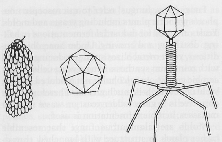
Figure 1: three different types of viruses Parasitic protozoa
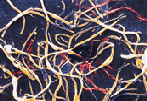
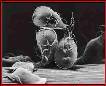
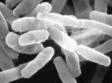
Figure 2: E. Coli bacteria One drop of feaces contains millions of microorganisms. In the faeces of cattle there can be millions of E. Coli bacteria (figure 2), Giardia cysts (figure 3) and Cryptosprodium spores (figure 4). In chicken faeces pathogenic bacteria such as Salmonella and Campylobacter can be present. When fertilizers are applied to land, rain can cause bacteria to rinse out te surface water or groundwater, causing the microorganisms to contaminate water.
Figure 3: Cryptosporidium spores Figure 4: Giardia cysts Sewer or waste water cannot be discharged into the environment untreated. The larger part of purified waste water ends up in rivers, lakes and oceans. Sometimes heavy rainfall can cause sewer systems to flood, causing untreated water to end up in surface water or groundwater. Not every country purifies water before it enters surface or groundwater. Mainly developing countries lack sanitary facilities. The water can contaminate water that is used for drinking water purposes, causing the risk of infection with diseases carried by waterbone microorganisms to become very high. this is a particular risk when drinking water is not treated at all. When septic tanks are used for waste water treatment, pathogenic microorganisms can contaminate surface water and groundwater sources.
Figure 5: Legionella bacteria More information on water disinfection?: Introduction water disinfection Necessity water treatment History of drinking water treatment What is water disinfection? Necessity of drinking water disinfection History of water disinfection Waterborne diseases Factors that influence disinfection Conditions of water disinfection Regulation drinking water disinfection EU USA Swimming pool treatment Swimming pool pollutions Swimming pool disinfection Swimming pool disinfection & health Cooling tower water Cooling tower water pollutions Cooling tower water disinfection Cooling tower water legislation Chemical disinfectants Chlorine Sodium hypochlorite Chloramines Chlorine dioxide Copper silver ionization Hydrogen peroxide Bromine Peroxone Peracetic acid Disinfection byproducts Types of disinfection byproducts Research on health effects of disinfection byproducts |