Bromine
Bromine can be used for the disinfection of swimming pool and cooling tower water. It is not used for the disinfection of drinking water.
When was bromine discovered?
In 1825, C. Löwig, a German chemistry student was conducting research on (magnesium bromide-rich) water from swamps. After he removed chlorine, he injected chlorine gas into the solution. During this process a new substance emerged; bromine. Löwig isolated bromine through extraction with ether and through distillation. A French chemist, A. Ballard, discovered bromine in an extract of seaweed from which he had removed chlorine. Ballard developed industrial methods to isolate various salts from seawater. The word bromine comes from the Greek word bromos (= smell). It refers to the unpleasant, stinging odor of bromine.
What are the characteristics of bromine?
Bromine has the atomic number 35. Like chlorine, it is a halogen and it easily reacts with other elements. In nature bromine can only be found in compounds. These combinations are called bromides. Bromides are used to obtain pure bromine and to produce bromine products. After fluorine, bromine is the most reactive element. It reacts with many different substances, is very corrosive and destructive on organic material.
Bromine is the only non-metallic element that is liquid at room temperature and standard pressure. It is a red liquid that easily evaporates and smells. Bromine is approximately 3,12 times heavier than water. At temperatures of 58,8 °C it becomes gaseous, whereas at –7,3 °C and lower temperatures it is a solid.
Bromine is a bleach. It is poisonous in fluid form and bromine vapor is destructive for the human skin, eyes and respirational tract. It causes serious burns. A concentration of 1 ppm can cause eye watering and when inhalation of concentrations below 10 ppm occurs, one starts to cough and the respirational tracts are irritated.
Bromine can easily be dissolved in water (35 g per L water), carbon disulfide and other organic solutions. When added to water, bromine forms hypobromous acid. Hyprobromous acid is a weak acid. It partly dissociates to form hydrogen ions and hypobromite ions. The rate of hypobromous acid and hypobromite ions is determined by the pH value of the water. When the pH value is between 6.5 and 9 both hypobromous acid and hypobromite ions can be found in water.
If water contains ammonia nitrogen, bromamines will be formed (NH2Br, NHBr2 and NHBr3). For disinfection bromamines are as effective as hypobromous acid. Changing the pH value influences the amount of mono-, di- and tribromamine that is formed.
Where can bromine be found?
In nature bromine can be found as bromide salts or organic bromine substances. These substances are produced by several sea organisms. Bromine is mostly in soluble salts in seawater, salt lakes and brine.
Seawater contains approximately 65 ppm bromine. The bromine concentration found in brine is much higher, between 2500 and 10,000 ppm.
Bromine is obtained from brine sources in the United States of America and China, from the Dead Sea in Israel and Jordan and from oceanic water from Wales and Japan. Other bromine-rich areas are in France, Italy, Turkmenistan, Ukraine, Azerbeidzjan and Germany. Bromine can also be found in rocks and in the earth's crust.

Figure 1: bromine exists mostly as bromide salts in the sea
How can bromine be produced?
Bromine was first discovered in 1825, but it was not until 1860 that it was produced on a larger scale. In the old days bromine was produced by obtaining a reaction between bromides, pyrolusite and sulphuric acid.
MnO2 + 4 H+ + 2 Br- → Mn2+ + 2 H2O + Br2
Small amounts of bromine can also be obtained by obtaining a reaction between solid sodium bromide (NaBr) and concentrated sulphuric acid (H2SO4). At first, hydrogen bromine gas (HBr) is formed. The gas is oxidized by sulphuric acid into bromine and sulphur dioxide.
NaBr (s) + H2SO4 (l) → HBr (g) + NaHSO4 (s)
2HBr (g) + H2SO4 (l) → Br2 (g) + SO2 (g) + 2H2O (l)
Another method is the electrolysis of bromide solutions. On the positive electrode bromine is formed:
2 Br- → Br2 + 2 e-
Nowadays bromine is usually created by injection of chlorine into bromide-rich watery solutions with a pH of 3.5.
Seawater is treated with chlorine gas and air. Chlorine gas than oxidizes bromide to bromine. When chlorinated water is added to a watery solution containing bromides, the solution turns brown because of the formation of bromine.
2Br- + Cl2 → 2Cl- + Br2
What are the applications of bromine?
The first known application of a bromine-containing product is the color purple. This substance is produced by purple snails and was used by the Romans to paint their clothes purple. This is a very demanding activity and only the richest Romans could buy these clothes.
Nowadays bromine has many applications. In industry and agriculture it is used on a large scale to produce bromine-containing substances. Bromine was used mainly to produce ethyleen dibromide; a constituent of lead-containing fuel. Because of its damaging effects on the environment, this product is no longer used. Bromine is applied in brominated flame retardants, in medicines, in photography, in oil production, in paints and in pesticides. In water treatment bromine is used as an alternative for swimming pool disinfection, and for cooling tower disinfection by chlorine.
Disinfection with bromine
In the United States bromine has been used since the 1930's for the disinfection of water.
Can bromine be used for the disinfection of swimming pools?
Bromine substances are disinfectants and can be used as an alternative for chlorine. In swimming pools, bromine is used against the formation and growth of algae, bacteria and odors in swimming water. In the United States, bromine has been used since 1936 to treat swimming water. During World War II, chlorine became scarce and many swimming pools started to use bromine for disinfection instead.
Bromine can be applied in fluid form or in a mixture. When bromine is applied in fluid form, the following equilibrium is established:
Br2 + 2H2O « HOBr + H3O+ + Br-
HOBr + 2H2O « OBr- + H3O-
This equilibrium strongly depends on the pH value. At the pH value that is usually found in swimming pools, bromine is mainly present as hypobromous acid (HOBr). Bromine has to be used combined with an oxidizing agent (for example chlorine or ozone).
Br2 + 2H2O « HOBr + H3O+ + Br-
HOBr + 2H2O « OBr- + H3O-
Table 1: influence of the pH on the formation of hypobromous acid.
| Hypobromous acid (HOBr) |
|
hypobromite ion (OBr-) |
| % bromine as HOBr |
pH |
% bromine as OBr- |
| 100 |
6,0 |
0,0 |
| 99,4 |
6,5 |
0,6 |
| 98,0 |
7,0 |
2,0 |
| 94,0 |
7,5 |
6,0 |
| 83,0 |
8,0 |
17,0 |
| 57,0 |
8,5 |
43,0 |
A bromine-containing stick was developed in 1958, because of the risks of using fluid bromine. This stick exists of bromine-chlorine-dimethylhydantoin (Dihalo, DMH). Both chlorine and bromine are attached to a nitrogen atom, which acts as an organic support. Applied to water, DHM is hydrolyzed and forms hypochlorous acid. Some HOCl is formed as well. The hypochlorite ion reacts with bromides to form hypobromous acid. Bromine-chlorine-dimethylhydantoine (BCDMH) is an organic substance; after disinfection and oxidation free bromine remains. When BCDMH is dissolved in water, hypobromous acid and hypochlorous acid are released. Those substances react with bromides (Br–), causing additional hypobromous acid to be produced. This is why bromine can be used both as a disinfectant and as an oxidizing agent. The concentration of BCDMH in water should not reach 200 mg/L or higher, otherwise the equilibrium between the residual disinfectant and the organic matter is disturbed. An advantage of BCDMH is that it is harmless when it is stored. It is easy to apply. Occasionally, the pH value has to be adjusted.
BCDMH is provided as tablets or cartridges. It has a long shelf life and it dissolves very slowly. Another system that can be used is dissolving bromine salt (sodium bromide) in water and activating it by the addition of an oxidator (hypochlorite or ozone). At first, salt is added to the water. Second, the oxidator is added to activate the bromine and hypobromous acid is formed.
During disinfection, hypobromous acid dissociates into bromide ions. These ions can be reactivated.
Bromine reacts with other substances in the water to form bromine-containing substances. These substances are disinfectants and do not give off odors. Bromine does not oxidize ammonia or other nitrogen substances. Hypobromous acid reacts with sunlight.
When the pH value is between 7 and 8,5 dibromoamine is the most common form of bromine. Dibromoamine is almost as effective as free chlorine in killing microorganisms. Dibromoamine is very active and usually dissociates quickly into bromide ions. Because of this, no bromine remains in the water.
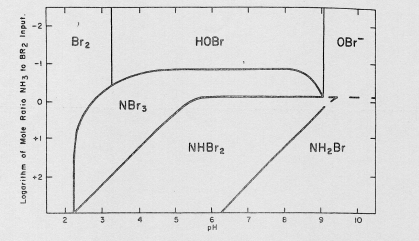
Figure 2: different forms of bromine at various pH values and various concentrations of ammonia.
The most important bromide substances used as a biocide are sodium bromide and BCDMH.
Can bromine be used for the disinfection of drinking water?
Free bromine (Br2) is not used in drinking water treatment. It reacts far to quickly with organic substances, and no residue will remain. Bromine gives drinking water a terrible medicine-like taste. Bromine should only be used in emergency cases.
Is bromine used for the disinfection of cooling tower water?
Bromine can be used for the disinfection of cooling tower water. Hypobromous acid is slightly less effective than hypochlorous acid in killing microorganisms. The pH value of the cooling water determines which form of bromine is present. When the pH value is below 8,7, more hypobromous acid (HOBr) is formed. This is more effective than hypobromite ions, which will be more abundant above pH 8,7. This is why bromine is a better disinfectant for alkalic cooling tower water than chlorine. At pH 7,6 and higher, mainly hypochlorite ions are formed. These are less effective than hypochlorous acid. Bromine reacts with ammonia to form bromamines. In contrast to chloramines, bromamines are unstable and will dissociate into hypobromous acid. Most microorganisms in cooling towers can be treated with bromine, as long as there is enough bromine present.
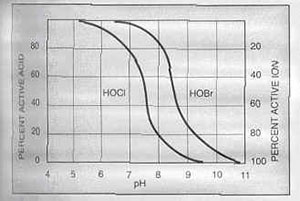
Figure 3: dissociation of hypobromous acid and hypochlorous acid at various pH values
What are the advantages and disadvantages of bromine use?
Advantages
Bromine dissolves in water three times better than chlorine. No dangerous gasses are required for bromine production. Bromine's activity in water is short, because it does not bind strongly. The advantage is that the residual concentration is low and no separate substances are required to remove bromine.
Disadvantages
Bromine is very reactive. To maintain an adequate disinfection, the amount of bromine that is added must be high. Bromine aggressively reacts with metals and it is a corrosive material.
Security measures should be taken when bromine is transported, stored or used.
What is the efficiency of bromine?
The bromamines which are formed when bromine is added to ammonia-rich water are as effective as free chlorine in killing pathogenic microorganisms.
What are the health effects of bromine use?
Bromine concentrations around 0.5 mg/L in swimming pools cause eye and mucous membrane irritation and can lead to odor nuisance.
In nature bromine is found in inorganic substances. During the twentieth century, humans have produced organic bromine for several applications. Organic bromine is not a natural substance and causes severe damage to the environment. Humans can obtain organic bromine through the skin, through food uptake and through inhalation. It is widely used as a spray to kill insects and other unwanted pests. Organic bromine is dangerous for humans and animals. It effects the thyroid gland, genetic material and nerve system.
What are the environmental effects of bromine use?
Bromine is used as a disinfectant, because it is harmful for microorganisms. When organic bromine enters surface waters, it has negative effects on the health of water fleas, fishes, lobsters and algae.
When bromine is used to disinfect water, bromamines and hypobromous acid react with organic matter in the water to form brominated disinfection byproducts. These can be harmful to human health.
What is the legislation for the use of bromine?
EU
In France bromine is used to disinfect swimming pools. The French standard for bromine in swimming pools is 0,7 mg/L. Concentrations of 0,5 mg/L lead to irritations on mucous membranes, eyes and odor nuisance.
|